
The street seemed to slow the moment Willie Nelson’s bronze statue came into view. Even the bustling energy of downtown Austin quiets in its presence. People don’t simply pass by—they pause, look up, and stand in quiet reverence for a figure whose music has soundtracked American life for more than six decades.

On April 20, 2012, the city of Austin unveiled an eight-foot-tall bronze statue of Willie Nelson outside the Austin City Limits studios on what is now Willie Nelson Boulevard. Sculpted by Clete Shields and commissioned by the nonprofit Capital Area Statues, the piece captures the Red Headed Stranger perched on a stool, braids flowing, bandana in place, and his beloved guitar Trigger slung across his lap. It is not just a monument. It is gratitude made visible.
Willie Nelson has never been easy to contain in a single label. He is a singer, songwriter, guitarist, activist, poet, farmer’s champion, and the spiritual godfather of outlaw country. At 93 years old in 2026, he remains a living embodiment of creative freedom, resilience, and unapologetic individuality. This bronze tribute honors not only his fame but the endurance that made him an icon.

The Outlaw Spirit Captured in Metal
The statue reflects the very essence of the outlaw country movement that Nelson helped define in the 1970s. Tired of Nashville’s polished production and restrictive rules, Nelson, along with Waylon Jennings, Kris Kristofferson, and others, forged a raw, honest sound that celebrated life’s rough edges. Songs like “On the Road Again” became anthems of restless freedom, while “Always on My Mind” turned regret into something achingly beautiful.
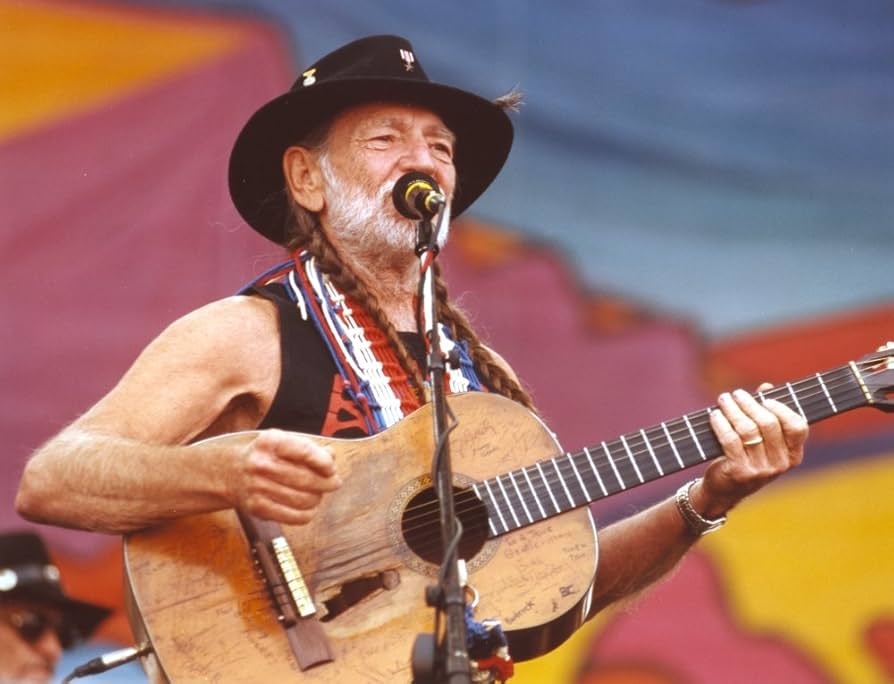
The sculpture, weighing about a ton, shows Nelson in his signature style: relaxed yet commanding, guitar in hand, ready to play. Visitors often say they can almost hear the worn strings of Trigger—the Martin N-20 that has accompanied him through thousands of shows—resonating in the air around the statue. Trigger itself is legendary, its body covered in signatures and scars from decades of use. In the bronze, that spirit of lived-in authenticity endures.
A Life Lived on the Road and in Song
Nelson’s journey began in Abbott, Texas, during the Great Depression. He wrote his first song at age seven and performed on the radio as a child. After stints in the Air Force, selling encyclopedias, and working as a disc jockey, he moved to Nashville in the 1960s as a songwriter. He penned hits for others—“Crazy” for Patsy Cline, “Hello Walls” for Faron Young—before breaking through as a performer in his own right.
But mainstream success felt confining. In 1973, he released Shotgun Willie, marking his shift toward a more personal, outlaw sound. Albums like Red Headed Stranger (1975) and collaborations such as Wanted! The Outlaws cemented his place as a genre revolutionary. His voice—warm, weathered, instantly recognizable—carries both tenderness and defiance.
Beyond music, Nelson’s impact runs deep. He co-founded Farm Aid in 1985, raising awareness and funds for family farmers. He has advocated for marijuana legalization, animal rights, and veterans’ causes. His IRS battle in the early 1990s, which nearly bankrupted him, became another chapter in his legend of survival. Through it all, he kept playing, kept writing, and kept connecting with everyday people.
Why the Statue Feels So Personal
Fans who visit the statue on Willie Nelson Boulevard describe an emotional pull. The figure doesn’t feel distant like many monuments. It feels like an old friend waiting at the edge of a song. Parents bring children who grew up hearing “Blue Eyes Crying in the Rain.” Tourists snap photos beside the braids and bandana. Locals pause during lunch breaks, remembering how Nelson’s music played in their trucks, kitchens, and at family gatherings.
The location is perfect—steps from the ACL studios where Nelson performed early on and helped put Austin on the map as the “Live Music Capital of the World.” The unveiling on 4/20 at 4:20 p.m. was classic Willie: timed with both convenience and his well-known affinity for the date. He attended, performed “On the Road Again,” and quipped about being “stoned one thousand years.”
A Legacy That Transcends Bronze
In 2026, Willie Nelson continues to tour selectively, release music, and surprise fans with appearances. His most recent projects blend new originals with reimagined classics, proving that age has not dimmed his creative fire. The statue reminds us that legends don’t retire—they simply keep moving down the road.
It also highlights a broader truth about American culture. Willie Nelson represents the idea that you don’t have to fit the mold to matter. You can wear your hair in braids, play a beat-up guitar, speak your mind, and still earn the love of millions. His music has comforted people in heartbreak, joined celebrations, and provided solace in lonely times. It feels lived because it is lived.
The bronze Willie stands steady and quiet, yet somehow alive. It does not replace the man who still walks among us. Instead, it points back to his living legacy—the songs, the causes, the friendships, and the unbreakable outlaw spirit. Visitors leave not just having seen a statue, but having remembered why his music matters so much.
They slow down because they are seeing more than metal. They are seeing memories. They are seeing the long highway of country music that Willie helped pave. They are seeing a man who became larger than entertainment by helping people feel the truth of their own lives.
Now he stands forever in bronze on a street named in his honor. Not just remembered. Not just honored.